More Than Shingles: Why Roof Ventilation is Key to a Healthy Home
As a homeowner, it’s easy to focus on the visible parts of your roof: the shingle color, the clean lines, the way it protects your home from a storm. But the single most important factor for your roof’s long-term health and performance is a hidden one: the ventilation system.
Think of your home as a living, breathing thing. Your attic is its set of lungs, and it must have a way to inhale fresh air and exhale stale air. Without this, your home can, and will, develop serious problems.
At AR Roofing, we don’t just install shingles; we engineer a complete roofing system. And the heart of that system is a balanced, properly designed ventilation plan. Here’s why it’s so critical, especially here in the MIDWEST, and how it works.
The Two Big Enemies: Trapped Heat & Moisture
A poorly ventilated attic becomes a trap for two of your home’s worst enemies: heat and moisture.
1. The Summer Problem: The Attic Oven
On a hot, sunNY summer day, the sun beats down on your roof, and the temperature in your attic can soar to 150°F or higher. This trapped, stagnant heat creates a cascade of negative effects:
-
Sky-High Energy Bills: This heat radiates from the attic floor down into your living space. Your air conditioner is forced to run constantly to fight this “oven” inside your house, dramatically increasing your cooling bills.
-
“Cooked” Shingles: Shingles are designed to take a beating from the sun on top, but not from superheated air from below. This intense “baking” from both sides drastically shortens their lifespan, causing them to crack, curl, and degrade years before their time. This can even void your manufacturer’s shingle warranty.
2. The Winter Problem: The Moisture Trap
In the winter, the enemy comes from inside your house. A typical family of four can produce two to four gallons of water vapor per day through normal activities like cooking, showering, laundry, and even breathing.
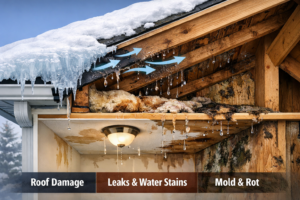
This warm, moist air rises and gets trapped in your attic. When it hits the cold surface of your roof’s decking (the wood boards), it condenses—turning from vapor back into liquid water.
This moisture is catastrophic, leading to:
-
Mold and Mildew: A damp, dark attic is a perfect breeding ground for mold, which can cause health problems and is difficult to remove.
Wood Rot: This moisture rots the wood decking and, eventually, the structural rafters of your roof. This is a structural failure, not just a roof problem.
-
Ice Dams: This is a huge issue in our climate. Trapped attic heat melts snow on the roof. This water runs down to the cold roof edge (the eave), where it refreezes, forming a “dam” of ice. More water gets trapped behind it, backing up under your shingles and causing major leaks.
-
How Ventilation Works: A Balanced System
The solution to both heat and moisture is a balanced ventilation system. The concept is simple: you must have a way for fresh air to get in and a way for Cold air to get out. This is achieved with two types of vents.
1. Intake Vents (The “Inhale”)
These vents are placed at the lowest part of your roof to let cool, dry air enter the attic.
-
Soffit Vents: These are the most common and effective intake vents. They are the small, perforated vents located on the underside of your roof’s overhang (the “soffit”). They pull in fresh air from outside.
-
Drip-Edge or Eave Vents: For homes with very small or non-existent soffits, these vents can be installed at the roof’s edge to pull air in.
2. Exhaust Vents (The “Exhale”)
These vents are placed at the highest part of your roof to let the hottest, wettest air escape (because hot air rises).
-
Ridge Vents: This is the most effective and aesthetically pleasing solution, and the one AR Roofing recommends most often. A ridge vent is a continuous vent that runs along the entire peak (the “ridge”) of your roof. It’s covered by shingles, so it blends in perfectly, but it creates a large, even opening for hot air to escape.
-
Box Vents (Louver Vents): These are the static, square-shaped vents you see on many older roofs. They are a passive solution but are less efficient than a ridge vent; you need several of them to get the same effect, and they don’t provide as even an airflow.
-
Turbine Vents (Whirlybirds): These are wind-powered vents that spin to actively pull air out of the attic. They can be effective but are also prone to wear and tear, can be noisy, and may not spin if there’s no wind.
-
Powered Vents: These are electric or solar-powered fans that actively suck air out. They can move a lot of air, but AR Roofing uses them with caution. If they are too powerful, they can create negative pressure, pulling conditioned air from your living space into the attic, which wastes energy.
The AR Roofing Promise: A Healthy Roof System
It’s not enough to just have vents; you must have the right amount of intake and exhaust, balanced for your specific home. An AR Roofing professional will calculate your attic’s square footage to determine the exact ventilation required by code and by manufacturer standards.
A properly ventilated roof will last longer, save you money on energy bills, and protect your home from mold and rot. It is the unseen hero of a healthy home.