By A-R Roofing | Trusted. Local. Since 1995.
More Than Shingles: Why Roof Ventilation is Key to a Healthy Home
When homeowners think about their roof, they usually think about shingles, gutters, leaks, or storm damage. Ventilation is easier to overlook because most of it happens out of sight in the attic. But in our experience at A-R Roofing, roof ventilation is one of the most important parts of a healthy roofing system.
Your roof does more than keep rain, snow, hail, and wind out of your home. It also needs to help control heat and moisture. When your attic cannot breathe properly, trapped air can shorten the life of your shingles, raise indoor temperatures, contribute to mold growth, and create winter problems like ice dams.
In this guide, we’ll explain what roof ventilation does, how intake and exhaust vents work together, the signs of poor roof ventilation, and when it makes sense to have your attic and roofing system inspected.
A-R Roofing provides roofing, storm damage, gutter, and exterior services across Kansas, Nebraska, Missouri, and Oklahoma, and we look at ventilation as part of the full roofing system, not as an afterthought.
What Roof Ventilation Means
Roof ventilation is the system that allows air to move through your attic. A properly ventilated attic has two sides working together:
| Ventilation Part | What It Does | Common Examples |
|---|---|---|
| Intake ventilation | Lets cooler outside air enter the attic, usually from the lower part of the roof system | Soffit vents, eave vents |
| Exhaust ventilation | Lets hot, moist attic air escape from the upper part of the roof system | Ridge vents, box vents, turbine vents, powered attic vents |
A simple way to think about it is this:
Fresh air comes in low. Hot, moist air exits high.
When that airflow is balanced, the attic can release heat and moisture instead of trapping them under the roof deck. When it is not balanced, the attic can become too hot in summer, too damp in winter, or both.
If you are planning a roof replacement or want to understand how ventilation fits into the bigger picture, our team can evaluate it as part of our professional roofing services.
How Intake and Exhaust Work Together
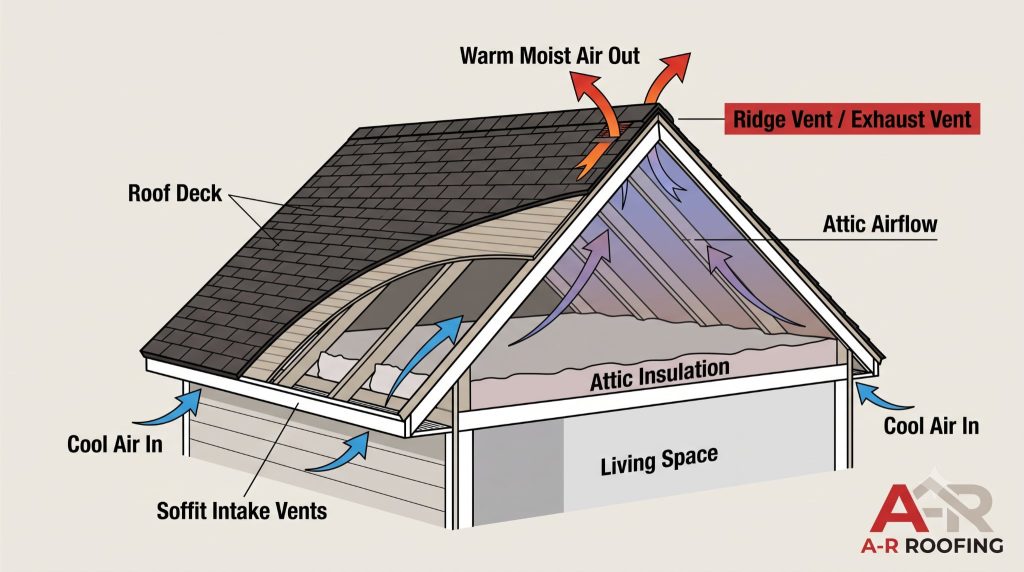
Good ventilation is not just about adding more vents. It is about balance.
Your attic needs enough intake ventilation to bring air in and enough exhaust ventilation to let air out. If one side is missing or undersized, the system may not work properly.
For example:
- If there is exhaust but not enough intake, vents may pull air from the living space instead of the outside.
- If there is intake but not enough exhaust, hot and moist air may stay trapped in the attic.
- If vents are blocked by insulation, paint, debris, or poor installation, airflow can be reduced even if the vents are present.
- If too many different exhaust vent types are mixed together, they can sometimes compete with each other instead of improving airflow.
That is why we do not look at attic ventilation as a single product. We look at the full system: soffits, ridge vents, box vents, roof deck condition, attic insulation, roof age, shingle condition, and moisture signs.
Why Roof Ventilation Matters in Summer
During hot weather, your attic can become much hotter than the temperature outside. Without proper airflow, heat builds up under the roof deck and can affect both your comfort and your roof.
Poor summer ventilation can lead to:
- Hot upstairs rooms
- Higher cooling costs
- Overworked air conditioning
- Premature shingle aging
- Heat damage to roof decking
- A less comfortable home
When hot attic air has nowhere to go, it can radiate down into the living space. Your air conditioner may have to work harder, especially in homes with upper floors or finished attic spaces.
Ventilation does not replace insulation, and insulation does not replace ventilation. The two need to work together. Insulation helps slow heat transfer, while ventilation helps remove trapped hot air and moisture from the attic.
Why Roof Ventilation Matters in Winter
Roof ventilation is not only a summer issue. In winter, warm air from inside the home can rise into the attic. If that air carries moisture and the attic is too cold or poorly ventilated, condensation can form on the underside of the roof deck, rafters, nails, or insulation.
Over time, winter moisture problems can lead to:
- Mold or mildew in the attic
- Damp or compressed insulation
- Rusted roofing nails
- Dark staining on roof decking
- Wood rot
- Musty odors
- Ice dam formation
Ice dams are a common winter roofing problem. They can happen when heat trapped in the attic warms the roof surface and melts snow. That melted snow runs down toward the colder roof edge, refreezes, and creates a ridge of ice. As more water backs up behind the ice, it can work under shingles and cause leaks.
Balanced ventilation helps keep the roof deck temperature more consistent, which can reduce the conditions that contribute to ice dams.
Signs of Poor Roof Ventilation
Many homeowners do not know they have a ventilation problem until it starts causing visible damage. The good news is that there are warning signs you can look for.
Here are some of the most common signs of poor roof ventilation:
| Sign | What You May Notice | Why It Matters |
| Hot upstairs rooms | Bedrooms or upper levels feel much warmer than the rest of the house | Heat may be trapped in the attic and radiating into the living space |
| High cooling bills | Energy costs rise even when your thermostat habits have not changed | Poor airflow can make your air conditioner work harder |
| Musty attic odors | The attic smells damp, stale, or musty | Moisture may be building up instead of escaping |
| Mold or dark staining | Dark spots on roof decking, rafters, or insulation | Condensation may be collecting inside the attic |
| Rusted nails | Nail tips under the roof deck look rusty or wet | Moisture may be condensing on metal surfaces |
| Wet or compressed insulation | Insulation feels damp, flattened, or discolored | Moisture reduces insulation performance and can lead to damage |
| Ice dams in winter | Ice builds along the roof edge after snow | Heat and airflow problems may be contributing to uneven roof temperatures |
| Curling or aging shingles | Shingles look curled, brittle, or prematurely worn | Excess attic heat can shorten shingle life |
| Peeling paint near ceilings | Paint bubbles or peels near upper walls or ceilings | Moisture may be affecting interior surfaces |
| Condensation on roof decking | Moisture appears on the underside of the roof deck | The attic may not be releasing humid air properly |
One sign by itself does not always mean the roof ventilation system has failed. But if you notice several of these issues, it is worth having the attic and roof inspected.
A Simple Roof Ventilation Check for Homeowners
We do not recommend climbing onto your roof to check vents. However, there are a few safe things you can look for from the ground or inside the attic if access is safe.
From outside the home, look for:
- Ridge vents along the roof peak
- Box vents, turbine vents, or other exhaust vents
- Soffit vents under the eaves
- Blocked or painted-over vent openings
- Damaged vents after a storm
- Missing, bent, or loose vent covers
Inside the attic, only if it is safe, look for:
- Damp insulation
- Rusted nail tips
- Dark stains on the underside of the roof deck
- Musty smells
- Daylight blocked where soffit vents should allow airflow
- Bathroom or kitchen fans venting into the attic instead of outside
- Signs of previous leaks or condensation
If you see storm-related damage to vents, shingles, flashing, or gutters, it may be time to schedule an inspection with our storm damage roofing specialists. Severe weather can damage more than shingles, and roof vents are often part of the inspection process.
Common Roof Vent Types
Different homes need different ventilation setups. The right system depends on roof design, attic size, soffit design, insulation, local building requirements, and manufacturer recommendations.
Common roof and attic ventilation types include:
| Vent Type | Intake or Exhaust | How It Helps |
| Soffit vents | Intake | Bring outside air into the attic from the lower roof edge |
| Ridge vents | Exhaust | Let hot, moist air escape along the roof peak |
| Box vents | Exhaust | Provide exhaust airflow through individual roof vents |
| Turbine vents | Exhaust | Use wind movement to help pull air from the attic |
| Powered attic vents | Exhaust | Use a motor to remove attic air, but must be balanced with proper intake |
| Gable vents | Usually exhaust or cross-ventilation | Allow air movement through attic wall openings, depending on the system design |
More vents are not always better. The wrong combination of vents can create airflow problems. For example, adding a powered attic fan without enough intake can pull conditioned air from the living space or reduce the effectiveness of other vents.
That is why a roof ventilation system should be designed, not guessed.
How Much Ventilation Does a Roof Need?
Ventilation needs are usually calculated based on attic square footage and net free ventilation area, often called NFVA. NFVA refers to the actual open area that allows air to pass through a vent.
In simple terms, a larger attic usually needs more ventilation than a smaller attic. But the amount of ventilation is not the only factor. The balance between intake and exhaust matters too.
When A-R Roofing evaluates ventilation, we look at:
- Attic square footage
- Existing intake ventilation
- Existing exhaust ventilation
- Whether soffit vents are blocked
- Roof shape and ridge length
- Attic insulation levels
- Signs of heat or moisture damage
- Shingle manufacturer requirements
- Local building expectations
- Whether the current ventilation setup may affect roof performance
We avoid giving a one-size-fits-all answer because every home is different. The correct approach depends on the structure, the roof system, and the manufacturer guidelines for the roofing materials being installed.
Ventilation and Shingle Warranties
Proper ventilation can also matter for roof material performance. Many roofing manufacturers include ventilation requirements in their installation guidelines. If an attic is poorly ventilated, shingles may be exposed to excess heat and moisture that can contribute to premature aging.
That does not mean every shingle issue is caused by ventilation. Storm damage, age, installation quality, material defects, and maintenance can all play a role. But ventilation is one of the key conditions we check when evaluating roof performance.
If your shingles are curling, cracking, losing granules, or aging faster than expected, ventilation may be part of the problem.
Ventilation, Gutters, and the Whole Roofing System
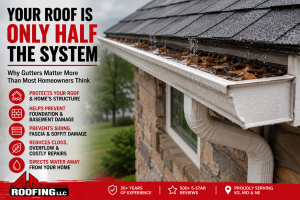
Roof ventilation works above the attic, but the full roof system also includes drainage. Gutters move water away from the roof edge, fascia, siding, and foundation. If gutters are clogged, damaged, or pulling away from the home, moisture problems can become worse around the edges of the roof.
That is why we often look at both roof ventilation and water drainage during exterior inspections. If your home has damaged or failing gutters, our team can help with gutter repair and replacement services that support the overall protection of your home.
When to Have Your Roof Ventilation Inspected
You should consider a professional ventilation inspection if:
- Your attic feels extremely hot in summer
- Your upstairs rooms are uncomfortable
- You notice mold, moisture, or musty odors in the attic
- Your roof has ice dams in winter
- Your shingles appear to be aging too quickly
- Your energy bills have increased without a clear reason
- Your roof vents were damaged by hail, wind, or debris
- You are replacing your roof
- You are adding insulation
- You are buying or selling a home
Ventilation is easiest to correct when roofing work is already being planned. During a roof replacement, we can inspect the roof deck, evaluate intake and exhaust, and recommend ventilation improvements that fit the home.
If roof replacement or ventilation upgrades are needed, A-R Roofing also offers roofing financing options to help homeowners plan the project without delaying necessary work.
Why Work With A-R Roofing?
At A-R Roofing, we know a roof is more than the shingles you see from the street. A strong roofing system includes proper installation, ventilation, flashing, drainage, storm protection, and ongoing maintenance.
When we inspect a roof ventilation issue, we look for the cause of the problem, not just the symptom. We check how air moves through the attic, whether vents are blocked or unbalanced, and whether heat or moisture has already affected the roofing system.
We serve homeowners and businesses across Kansas, Nebraska, Missouri, and Oklahoma, including areas that deal with high winds, hail, heavy rain, snow, and fast-changing Midwest weather.
Schedule a Roof Ventilation Inspection
If your roof is showing signs of poor ventilation, or if your attic feels too hot, damp, or musty, A-R Roofing can help you understand what is happening and what your options are.
Our team can inspect your roof, attic, vents, shingles, gutters, and moisture warning signs to determine whether your home has a ventilation problem or another roofing issue.
Contact A-R Roofing to schedule a professional roof ventilation inspection and get honest recommendations for protecting your home.